Showing posts with label Elasticity. Show all posts

Mechanical Properties of Solids Problems with Solutions Four

We are solving series of problems of on the topic called mechanical properties of solids. Solid material has molecules attached very close to  each other and they have strong force of attraction among them. When some external force is applied on the body, its molecules are disturbed and distance between them increases and hence body looses its shape temporarily. When the applied force is withdrawn, internal potential energy pulls the molecules back to the original position and hence body will all most recover its original shape. This property is called elasticity and it is the property of the given solid material and it depends on the nature of the material. Elastic property of the material is studied with a physical quantity called modulus of elasticity.

Problem

A rubber cord of catapult has a known cross section and length. It is stretched by  a length 12 centimeter and a stone of mass 5 gram is released from it.If young's modulus of the rubber is given to us as shown in the diagram below, we need to measure the velocity with which the stone is released from the catapult ?


Solution

We know that when rubber is pulled from its original position, we have used some of our energy and that is stored in the rubber in the form of elastic potential energy. All this energy is given to the stone and it gets kinetic energy. So we can use law of conservation of energy and solve the problem as shown in the diagram below.


Problem

A steel wire of length one meter and known area of cross section is hung from a rigid support with a stone of volume 2000 centimeter square  hanging from the other end. We need to measure the decrease in the elongation of  the wire when the body is immersed in the water.


When the wire is under the load of the sphere the force acting on the wire is nothing but weight of the wire. When that load is immersed in the water, there is a new force called upthrust and hence the resultant force acting on the wire decreases. It is the difference between the weight and the upthrust. As a result the expansion of the wire also decreases.


Problem

A metal wire of length and area of cross section known is available. If the wire breaks due to a applied load, we need to know the rise in the temperature of the system and the problem is as shown in the  diagram below.


Solution

To solve this problem, we need to equate the strain energy to the heat energy generated in the system. Heat energy is in the form of specific heat and it is from that definition itself. By equating them, the problem is solved as shown in the diagram below.


Problem

One end of a long metallic wire of known length is tied to a ceiling and the other end is tied to a mass less spring of known spring constant. If the attached load is slightly pulled down down and released  it will oscillate with a time period and we need to find that time period and the problem is as shown in the diagram below.


Solution

The wire also behaves like a spring and we can find the spring constant equivalent of the wire and we can find it using the definition of Young's modulus. The other spring and this are in series and we can find the effective spring constant of the system as shown in the diagram below. We can also write the equation for the time period as shown in the diagram below.


Problem

A thin uniform metallic rod of mass M and length L is rotated with a angular velocity in a horizontal plane about a vertical axis passing through one of its ends. The tension in the middle of the rod has to be found and the problem is  as shown in the diagram below.


Solution

Let mass per unit length m, so that we can find the total mass of the wire as shown in the diagram below. We can find the centripetal force at any given instant using its definition. To find the total value, we shall integrate the equation as shown in the diagram below.


Related Posts

Mechanical Properties of Solids Problems with Solutions Two

Mechanical Properties of Solids Problems with Solutions Three


Mechanical Properties of Solids Problems with Solutions Three

We are solving series of problems on the topic mechanical properties of solids. Elasticity is the property of the solid material because of which it is able to recover its original  shape and size after removing the external force applied on the body. When the applied force is removed because of internal forces among the body molecules the body comes back to its original position. But this recovery can not happen completely and if that happens body is said to be perfectly elastic body. If the body fails to recover its original position, then the body is said to be plastic body. No body in the nature is neither perfectly elastic nor perfectly plastic. During this process of body loosing the shape some work is done and that work done is stored in the form of potential energy.

Problem

If the work done in stretching a wire by one millimeter is two joule,we need to measure the work done in stretching another wire of half the radius,half the length but made up of same material by the same extension. The problem is as shown in the diagram below.


Solution

We know that the work  done is stored in the form of potential energy and we know the formula to it. We need to express it in terms of same elongation as well as same Young's modulus and the solution is as given in the diagram below.


Problem

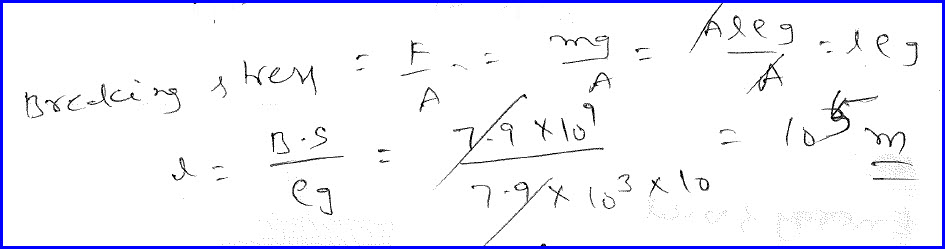
Breaking stress, density are given to us and we need to measure the maximum length of the wire that can be hung from a fixed support with out breaking that wire itself and the problem is as shown in the diagram below.


Solution

Breaking stress is the maximum stress that the body can experience with out breaking itself. It depends on the nature of the material but not on physical dimensions. It can be expressed in terms as the product of length of the wire, density of the wire and acceleration due to gravity as shown in the problem below.


Problem

Stress of the wire is given to us in the problem and we need to measure the force required to much a hole of diameter of one centimeter and the thickness of the wire is given to us. Problem is as shown in the diagram below.


Solution

Shearing stress can  be expressed as the shearing force per unit area. By applying the data, we can solve the problem as shown in the diagram below.


Problem

A wire of length one meter is fixed at one end has a sphere attached to it at the other end. The sphere is projected with a known velocity. When it describes a vertical circle, we need to find the ratio of elongations when the sphere is at the top as well as bottom. Problem is as shown in the diagram below.


Solution

We know that the velocity required for a body to complete vertical circle it need to different velocities at the bottom and top. We also know that when the body is at the top, gravity supports it to come down and vice versa. We also know that the tension in the wire which acts like a force here is minimum when the body is at the top and vice versa. Taking this into consideration, we can solve the problem as shown in the diagram below.


Problem

A cube of side known is subjected to known pressure from all the sides. We need to find the fractional change int he side of its cube where bulk modulus is given to us. Problem is as shown in the diagram below.


Solution

We can solve the problem using the definition of bulk modulus as shown in the diagram below. We know that bulk modulus is the ratio of bulk stress to the bulk strain. Problem is as shown in the diagram below. 


Related Posts

Mechanical Properties of Solids Problems with Solutions One

Mechanical Properties of Solids Problems with Solutions Two


Mechanical Properties of Solids Problems with Solutions Two

We are solving series of problems  based on mechanical properties of solids and one of the major property of the solids is elasticity due to which the solid materiel comes back to its original position, the body comes back  to its original position. It cannot come back to its original shape by hundred percent and to know by how much the body is able to recover its original position, we have a physical quantity called modulus of elasticity. It can be measured along the length using Young's modulus, along shape using Shearing modulus and along the volume it is measured with bulk modulus.

Problem

When a force is applied on a body of known surface area on the upper surface of the body keeping its lower surface fixed, the shift of the layer is given to us. Using the data given in the problem, we need to measure the rigidity modulus of the elasticity.


Solution

We know that rigidity modulus is the ability of a body to regain its original shape when the applied force is done on the upper surface and it is withdrawn. We can define it as the ratio of shearing stress to the shearing strain. Data can be applied and the problem cab be solved as shown in the diagram below.


Problem

Young's modulus of the wire is given to us and we need to measure the work done in the process per unit volume when the applied force is able to produce a known strain and the data is as shown in  the diagram below.


Solution

We know that when ever we apply force on a wire and it has produced some strain, we must have used some of our energy. That used energy can not disappear and it has satisfy the law of conservation of the energy. This energy is stored in the form of potential energy and it can be measured as shown in the diagram below.


Problem

A copper wires initial length and increase in the length is given to us and poisson's ratio is also given to us in the problem. We need to measure the lateral stain in the problem and the problem is as shown in the diagram below.


Solution

We know that poission's ratio is defined as the ratio of lateral strain to the longitudinal strain. When a force is applied along the length, its change in the length happens in the same direction and change in its width happens in the perpendicular direction. This change in the breadth to its original breadth is called lateral strain. For an ideal body, poission's ratio has to be equal to half and for all practical bodies, it is always less than that half. We can solve the problem by applying the definition as shown in the diagram below.


Problem

A steel bar of length one meter at zero degree centigrade is fixed between two rigid supports so that its length cannot be changed and its Young's modulus is given to us in the data as shown below. If coefficient of linear expansion of the material is also given to us, we need to measure the force developed in the wire when the temperature is raised.


Solution

We can rewrite the force in the Young's modulus in terms of the terms given in the data like coefficient of linear expansion. We can write the increase in the length from the definition and coefficient of linear expansion and the formula can be obtained as shown in the diagram below.


Problem

A stone of mass two kilogram is attached to one end of a wire of known area of cross section and length. If the breaking stress of the wire is given to us, we need to measure the number of revolutions that the wire can be revolved with out breaking the wire and the problem is as shown in the diagram below.


Solution

Breaking stress is the maximum stress that the wire can experience with out breaking itself. We can find the force as the product of breaking stress and area of cross section of the wire. This force acts like centripetal force and it can be expressed in terms of angular velocity. Problem can be solved as shown in the diagram below.


Problem

Length of the wire when applied force is four newton and five newton is given to us. We need to find the length of the wire when applied force is nine newton. Problem is as shown in the diagram below.


Solution

Both the lengths given in the problem are under the influence of force and hence its initial length is less than that. We can  express the increase in the length as the final length and initial length and it can be expressed in terms of the definition as solved in the diagram below.


Related Posts

Mechanical Properties of Solids Problems with Solutions One


Mechanical Properties of Solids Problems with Solutions One

We are going to solve series of problems on the physics topics mechanical properties of solids.We basically deal about the property called elasticity. It is the property of the body due to which it is able to regain its original position after removing the external force that is applied on that body. It is because of inter molecular force of attraction and restoring force of the molecules of the body. If the body is able to recover back to its original position well, then it is called elastic body and if not it is called a plastic body. We need to know that no body is perfectly elastic and no body is perfectly elastic.

Problem

When a metal sphere is suspended at the end of a metal wire, its extension is 0.4 millimeter. If another sphere of same materiel with the radius half to the first radius is suspended from the same wire, we need to find the extension in the wire. Problem is as shown in the diagram below.


Solution

Extension in the wire is directly proportional to the force applied on the wire. It is nothing but the weight of the sphere that is suspended. As the radius is given in the problem, we need to write its mass as the product of volume and density and volume is directly proportional to the cube of  the radius. So the extension of the wire is directly proportional to the cube of the radius of the load suspended and the problem can be further solved as shown in the diagram below.


Problem

The diameters of two steel wires are in the ratio of 2:3 and their lengths are equal.When same force is applied on both of them, we need to find the ratio of elongation produced in the two wires and the problem is as shown in the diagram below.


Solution

We can write the elongation of the wire in terms of the load applied and it is given in the problem that the load is same. So the stress as well as extension is inversely proportional to the area of cross section or inversely proportional to the square of the radius of the wire. Problem can be solved further as shown in the diagram below.


Problem

Area of cross section of the wire and the ratio  of extension of the wire in terms of its initial length is also given to us in the problem. We know the applied force and we need to find the young's modulus of the wire and the problem is as shown in the diagram below.


Solution

We know that young's modulus of the wire as the ratio of longitudinal stress to the longitudinal strain. Stress is defined as the ratio of applied force to the area of cross  section of the body and the stain is the ratio of change in the length to its original length. Problems data can be applied and solved as shown in the diagram below.


Problem

Two wires are made up of same material and their lengths and diameters ratio is given to us in the problem. If they are stretched by the same force, we need to find the ratio of the extensions in the two wires and the problem is as shown in the diagram below.


Solution

As the wires are same, their young''s modules is same for both of them. We can write equation for the elongation based on the defination  of the Young's modules and the problem can be further solved as shown in the diagram below.


Problem

If a rubber ball is taken into a 100 meter depths of water, its volume is changed by certain percentage and we need to measure the bulk modules of that material and the problem is as shown in the diagram below.


Solution

We know that bulk modulus is defined as the ratio of bulk stress to the bulk strain. Bulk stress is similar to the pressure applied on the system and it can be expressed in terms of the depth of the water. Bulk strain is the ratio of change in the volume of the body when compared with its initial volume. Data can be applied and problem can be solved as shown in the diagram below.


Related Posts
Gravitation Problems with Solutions Four

Mechanical Property of Solids Elasticity Complete Lesson

Solid is a state of matter in which particles are very close to each other and have strong force of attraction between. Thus a solid posses a strong shape. The particles of solid materiel tend to come back to the original positions when the applied external force is with drawn. This property is called elasticity. To measure the elastic property of a materiel, a physical quantity called modulus of elasticity is introduced. According to Hook's law, stress is directly proportional to strain with in the elastic limit. The ratio of stress and strain is constant and it is called modulus of elasticity. It depends on the nature of the solid but not on stress, strain and physical dimensions of the body.

Depending on how do we apply force on the body, three are three kinds of modulus of the elasticity and a detailed lessons are presented about all the relevant things of elastic property in the following lessons. 


Mechanical Properties of Solids and Fluids Complete Lessons

Under the title of Mechanical properties of solids and fluids there are multiple topics like elasticity,surface tension,fluid statics,fluid dynamics and viscosity.Here in this post we are going to post links of this topics for the sake of reference.

Elasticity is the property because of which the body comes back to its original state after removing the external force applied.

Fluid Statics deals with the fluids which can flow.The simple examples are liquids and Gases.When the fluids are in the state of rest they exhibit some properties and they were studied here.In fluid dynamics we deal with the fluids in the state of motion and their properties.In viscosity we deal with the opposition force acting against the motion.In surface tension we deal the property of liquids.

Elasticity


Surface Tension


Fluid Statics,Fluid Dynamics and Viscosity


Problems on Bernoulli's theorem and Its Applications