Showing posts with label Youngs Modulus. Show all posts

Mechanical Properties of Solids Problems with Solutions Three

We are solving series of problems on the topic mechanical properties of solids. Elasticity is the property of the solid material because of which it is able to recover its original  shape and size after removing the external force applied on the body. When the applied force is removed because of internal forces among the body molecules the body comes back to its original position. But this recovery can not happen completely and if that happens body is said to be perfectly elastic body. If the body fails to recover its original position, then the body is said to be plastic body. No body in the nature is neither perfectly elastic nor perfectly plastic. During this process of body loosing the shape some work is done and that work done is stored in the form of potential energy.

Problem

If the work done in stretching a wire by one millimeter is two joule,we need to measure the work done in stretching another wire of half the radius,half the length but made up of same material by the same extension. The problem is as shown in the diagram below.


Solution

We know that the work  done is stored in the form of potential energy and we know the formula to it. We need to express it in terms of same elongation as well as same Young's modulus and the solution is as given in the diagram below.


Problem

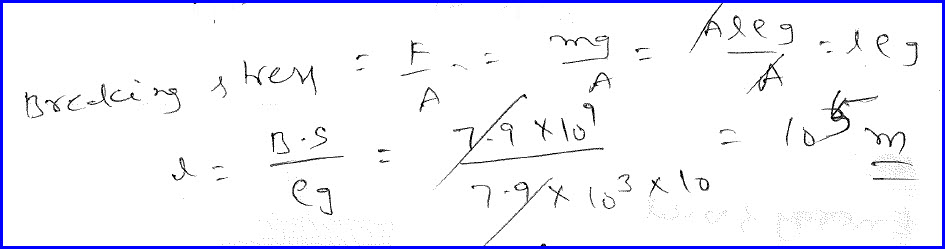
Breaking stress, density are given to us and we need to measure the maximum length of the wire that can be hung from a fixed support with out breaking that wire itself and the problem is as shown in the diagram below.


Solution

Breaking stress is the maximum stress that the body can experience with out breaking itself. It depends on the nature of the material but not on physical dimensions. It can be expressed in terms as the product of length of the wire, density of the wire and acceleration due to gravity as shown in the problem below.

Problem

Stress of the wire is given to us in the problem and we need to measure the force required to much a hole of diameter of one centimeter and the thickness of the wire is given to us. Problem is as shown in the diagram below.


Solution

Shearing stress can  be expressed as the shearing force per unit area. By applying the data, we can solve the problem as shown in the diagram below.


Problem

A wire of length one meter is fixed at one end has a sphere attached to it at the other end. The sphere is projected with a known velocity. When it describes a vertical circle, we need to find the ratio of elongations when the sphere is at the top as well as bottom. Problem is as shown in the diagram below.


Solution

We know that the velocity required for a body to complete vertical circle it need to different velocities at the bottom and top. We also know that when the body is at the top, gravity supports it to come down and vice versa. We also know that the tension in the wire which acts like a force here is minimum when the body is at the top and vice versa. Taking this into consideration, we can solve the problem as shown in the diagram below.


Problem

A cube of side known is subjected to known pressure from all the sides. We need to find the fractional change int he side of its cube where bulk modulus is given to us. Problem is as shown in the diagram below.


Solution

We can solve the problem using the definition of bulk modulus as shown in the diagram below. We know that bulk modulus is the ratio of bulk stress to the bulk strain. Problem is as shown in the diagram below. 


Related Posts

Mechanical Properties of Solids Problems with Solutions One

Mechanical Properties of Solids Problems with Solutions Two


Mechanical Properties of Solids Problems with Solutions Two

We are solving series of problems  based on mechanical properties of solids and one of the major property of the solids is elasticity due to which the solid materiel comes back to its original position, the body comes back  to its original position. It cannot come back to its original shape by hundred percent and to know by how much the body is able to recover its original position, we have a physical quantity called modulus of elasticity. It can be measured along the length using Young's modulus, along shape using Shearing modulus and along the volume it is measured with bulk modulus.

Problem

When a force is applied on a body of known surface area on the upper surface of the body keeping its lower surface fixed, the shift of the layer is given to us. Using the data given in the problem, we need to measure the rigidity modulus of the elasticity.


Solution

We know that rigidity modulus is the ability of a body to regain its original shape when the applied force is done on the upper surface and it is withdrawn. We can define it as the ratio of shearing stress to the shearing strain. Data can be applied and the problem cab be solved as shown in the diagram below.


Problem

Young's modulus of the wire is given to us and we need to measure the work done in the process per unit volume when the applied force is able to produce a known strain and the data is as shown in  the diagram below.


Solution

We know that when ever we apply force on a wire and it has produced some strain, we must have used some of our energy. That used energy can not disappear and it has satisfy the law of conservation of the energy. This energy is stored in the form of potential energy and it can be measured as shown in the diagram below.


Problem

A copper wires initial length and increase in the length is given to us and poisson's ratio is also given to us in the problem. We need to measure the lateral stain in the problem and the problem is as shown in the diagram below.


Solution

We know that poission's ratio is defined as the ratio of lateral strain to the longitudinal strain. When a force is applied along the length, its change in the length happens in the same direction and change in its width happens in the perpendicular direction. This change in the breadth to its original breadth is called lateral strain. For an ideal body, poission's ratio has to be equal to half and for all practical bodies, it is always less than that half. We can solve the problem by applying the definition as shown in the diagram below.


Problem

A steel bar of length one meter at zero degree centigrade is fixed between two rigid supports so that its length cannot be changed and its Young's modulus is given to us in the data as shown below. If coefficient of linear expansion of the material is also given to us, we need to measure the force developed in the wire when the temperature is raised.


Solution

We can rewrite the force in the Young's modulus in terms of the terms given in the data like coefficient of linear expansion. We can write the increase in the length from the definition and coefficient of linear expansion and the formula can be obtained as shown in the diagram below.


Problem

A stone of mass two kilogram is attached to one end of a wire of known area of cross section and length. If the breaking stress of the wire is given to us, we need to measure the number of revolutions that the wire can be revolved with out breaking the wire and the problem is as shown in the diagram below.


Solution

Breaking stress is the maximum stress that the wire can experience with out breaking itself. We can find the force as the product of breaking stress and area of cross section of the wire. This force acts like centripetal force and it can be expressed in terms of angular velocity. Problem can be solved as shown in the diagram below.


Problem

Length of the wire when applied force is four newton and five newton is given to us. We need to find the length of the wire when applied force is nine newton. Problem is as shown in the diagram below.


Solution

Both the lengths given in the problem are under the influence of force and hence its initial length is less than that. We can  express the increase in the length as the final length and initial length and it can be expressed in terms of the definition as solved in the diagram below.


Related Posts

Mechanical Properties of Solids Problems with Solutions One


Mechanical Properties of Solids Problems with Solutions One

We are going to solve series of problems on the physics topics mechanical properties of solids.We basically deal about the property called elasticity. It is the property of the body due to which it is able to regain its original position after removing the external force that is applied on that body. It is because of inter molecular force of attraction and restoring force of the molecules of the body. If the body is able to recover back to its original position well, then it is called elastic body and if not it is called a plastic body. We need to know that no body is perfectly elastic and no body is perfectly elastic.

Problem

When a metal sphere is suspended at the end of a metal wire, its extension is 0.4 millimeter. If another sphere of same materiel with the radius half to the first radius is suspended from the same wire, we need to find the extension in the wire. Problem is as shown in the diagram below.


Solution

Extension in the wire is directly proportional to the force applied on the wire. It is nothing but the weight of the sphere that is suspended. As the radius is given in the problem, we need to write its mass as the product of volume and density and volume is directly proportional to the cube of  the radius. So the extension of the wire is directly proportional to the cube of the radius of the load suspended and the problem can be further solved as shown in the diagram below.


Problem

The diameters of two steel wires are in the ratio of 2:3 and their lengths are equal.When same force is applied on both of them, we need to find the ratio of elongation produced in the two wires and the problem is as shown in the diagram below.


Solution

We can write the elongation of the wire in terms of the load applied and it is given in the problem that the load is same. So the stress as well as extension is inversely proportional to the area of cross section or inversely proportional to the square of the radius of the wire. Problem can be solved further as shown in the diagram below.


Problem

Area of cross section of the wire and the ratio  of extension of the wire in terms of its initial length is also given to us in the problem. We know the applied force and we need to find the young's modulus of the wire and the problem is as shown in the diagram below.


Solution

We know that young's modulus of the wire as the ratio of longitudinal stress to the longitudinal strain. Stress is defined as the ratio of applied force to the area of cross  section of the body and the stain is the ratio of change in the length to its original length. Problems data can be applied and solved as shown in the diagram below.


Problem

Two wires are made up of same material and their lengths and diameters ratio is given to us in the problem. If they are stretched by the same force, we need to find the ratio of the extensions in the two wires and the problem is as shown in the diagram below.


Solution

As the wires are same, their young''s modules is same for both of them. We can write equation for the elongation based on the defination  of the Young's modules and the problem can be further solved as shown in the diagram below.


Problem

If a rubber ball is taken into a 100 meter depths of water, its volume is changed by certain percentage and we need to measure the bulk modules of that material and the problem is as shown in the diagram below.


Solution

We know that bulk modulus is defined as the ratio of bulk stress to the bulk strain. Bulk stress is similar to the pressure applied on the system and it can be expressed in terms of the depth of the water. Bulk strain is the ratio of change in the volume of the body when compared with its initial volume. Data can be applied and problem can be solved as shown in the diagram below.


Related Posts

Gravitation Problems with Solutions Four

Problems and Solutions on Elasticity

Problem and solution

A metal ring of radius r and cross-section is a has to be fixed than a wooden circular disc of radius R. Assume that the radius of the disc is greater than that of the ring. What is the force acting on the ring ?

To fix the ring of the disc, we shall increase the size of the ring that is at least equal to the size of the disk. That is why we shall apply a force on the ring therefore its radius can be increased.


Problem and solution

A light rod of length 2 meter is suspended from the ceiling horizontally by means of the 2 vertical wires of the same length as shown.

One of the wire is made up of the steel and other one is made up of the brass and their respective areas of cross-sections are  given. Find the position along the broad at which a weight has to be suspended so that there may be equal stress on the both the wires and also find the location of the weight so that there will be equal strains on both the wires?


Density of the compressed liquid

Compressibility can be defined as the reciprocal of the bulk modulus. We can derive the equation for the density that how it is being effected if an external force is applied as shown below. We know as per the concept of the bulk modulus in the place of the change of the volume even we can write the change in the density and derive the equation as shown below.


Poisons ratio can be defined as the ratio of lateral strain to that of the longitudinal strain. Lateral strain is defined as the ratio of decreasing the thickness of the wire with respect to its original thickness. Longitudinal strain is defined as the ratio of increase the length of the wire to its original length.

These two strains are perpendicular to each other. While the longitudinal strain increases the length of the wire, the lateral strain decreases the thickness of the wire and hence it is shown with a negative sign.

Problem and solution

In the 1st problem volume of the material is given for you and it is also given that it is subjected to how much of the pressure if the corresponding change in the volume is also given in the problem we have to calculate the bulk modulus?

There are two  more different problems in the given now diagram and it can analyse them and comment back if you are having any  doubts.


We have two  more pages of the problems and solutions as attached below. You can go through the diagram by zooming in and you can comment at the end of the page ,if you are having any of the doubts regarding them.

While solving the first problem law of conservation of energy is taken into consideration.When the wire is stretched it has some energy called strain energy and this is converted into kinetic energy.

In solving the second problem we have taken into count that the increase in the length is directly proportional to  the applied force on the wire when all other terms are constant.


In solving the first problem we shall understand that the volume of the wire is constant.When its area changes,its length will change but total volume remains constant.

While solving the last problem, we are dealing with the weight of the body suspended.We can express that mass in terms of volume and density of the body and hence extension is directly proportional to its cube of the radius of the suspended body in spherical shape.


Related Posts

Experimental determination of Youngs modulus of the wire

To determine the modulus of elasticity we shall conduct the experiment. The experiment consists of two identical wires suspended from a rigid support.

Among the two wires one wire is a reference wire and the 2nd wire is an actual experimental wire. On the reference wire a fixed weight  is applied whereas on the experimental wire a variable weight  is applied.

A is arranged as shown in the diagram. Initially the apparatus is adjusted to a basic reading. When the load is increased , the reading of the vernier  calipers changes and basing on its concept we can calculate the increase in its length. Once if you know the increase in the length of the wire exactly calculating Young's modulus is very easy as shown below.


Breaking Stress and Its Applications

Breaking stress is the maximum stress that the body can withstand before it finally breaks. It is defined as the ratio of braking force per unit area. It depends on the nature of the material but it is independent of the physical dimensions of the body like area and  the length of the body.

Braking force can be defined as breaking stress multiplied with area. The braking force depends not only on the nature of the material but also on the area of the cross-section of the material.

So if you cut your wire to half of its original length, it is breaking stress remain same and even the braking force also remains the same.

If you cut the wire to half of its thickness, the breaking stress of the wire remains same but the braking force will be reduced to half.

It is quite possible that a very long wire due to its own weight can get the braking force and break. This particular Length is called braking length. While writing a equation for this, in the place of the weight we have to write mass of the body multiplied by the acceleration due to gravity. Basing on this concept we can read the equation further braking length of a wire as shown in the diagram below.


We can also calculate the increase in the length of the wire due to its own weight when the wire is not breaking. While solving this problem we shall consider that the entire mass of the wire is concentrated at the centre of the mass of the body and hence while calculating the length that we have to take only half of the length of the wire.The derivation for this is also shown in the above diagram.

Elastic fatigue is the phenomenon of the temporary loss of the elastic property due to the continuous application of the force on a body.Basing on this property by applying a force on a wire continuously at a particular point we can actually break it without cutting it.

Problem and solution

The length of a metal wire at tention T1 is L1 and its length is L2 for a tension T2. Find the original length of the wire when no forces applied on it?

As the given lengths of the wire  when a particular forces applied, we can consider L1 as original length plus some extra length. The same can be applied in the 2nd case also in the problem can be solved as shown below.


Related Posts

Behavior of a Wire under Increasing Load

We want to study how a wire behaves when we apply the force continuously on the body. By increasing the stress on the body continuously the corresponding strain is noted down and a graph is drawn between the stress and strain as shown. Here the stress is taken and y-axis and the strain is taken on x-axis.

When we do not apply any force on the body there is no stress and hence there is no strain. With the increase of the stress the strain also increases proportionately up to certain extent and the point up to where it happens is called as elastic limit. Many times this limit is also called as proportionality limit, it meant to say that for many bodies proportionality limit and the elastic limit coincides with each other.

When the stress is applied about this point the stress is not exactly directly proportional to strain but the particle will still have elastic nature. That means if you revert back the stress that we have applied strain also comes back and the graph retraces back to the origin.

Once if this elastic limit is crossed ,with respect to the increase of the stress the strain also increases but the proportionality is no more there. From this point we cannot retrace the graph which mean to say that when you decrease the stress strain is not going to completely disappear rather a small portion of the strain will exists forever. This kind of the arrangement is called permanent set. We can calculate the value of the permanent set has the product of the original length of the wire and the shift of the graph. This point is generally called as yielding point.

If the force is applied beyond the yielding point there will be a increase of the strain even when the stress is not increases significantly and  the wire start becoming thin. This can happen up to some extend and finally at a particular point the wire will break .This  point where the wire breaks is called as breaking point.

If there is a good gap between the yielding point and breaking point, that kind of the material is called ductile  materials and there are very much useful in making thin and long wires. Gold and copper are simple examples of this kind of the materials.

If there is no big gap between yielding point and the breaking point they cannot be molded into wires and this kind of the material is called as brittle materials. Glasses a typical example of a brittle material.


Related Posts