Showing posts with label Conduction. Show all posts

Transmission of Heat Problems with Solutions Three

We are solving series of problems on transmission of heat. Here we are talking about conduction, convection and radiation. Each method is little different and radiation is the fastest way of transmission of heat and it does not need any medium for the propagation. To know the magnitude of transfer of heat energy via radiation, we have Stephen’s law. As per it the rate of flow of heat energy is directly proportional to forth power of absolute temperature of the body. According Wien’s displacement law, the wave length corresponding to temperature of maximum heat energy are inversely proportional to the absolute temperature and the their product is constant and it is called Wien’s constant.

Problem

Three identical rods are connected in Y shape as shown in the diagram below. The temperature at each end is given to us and we need to find the temperature of the system at the junction.


Solution

We know that heat flows from a body of higher temperature to a body of lower temperature. Here heat energy starts flowing from 90 degree side to zero temperature. The sum of the heat that flows from two bodies of higher temperature shall be the heat through the third rod. Taking that into consideration and using the definition of thermal conductivity, we can solve the problem as shown in the diagram below.


Problem

One cylinder of less radius is kept in the hallow cylinder of higher radius as shown in the diagram below. The two materials are different and they have different coefficients of thermal conductivity. Each end of the system is at a different temperature and there is no loss of heat energy in the system and we need to find the effective thermal conductivity of the system.


Solution

These two cylinders acts as if like they are connected in parallel. The total flow of the heat is the sum of the heat flows through both the rods. Taking that into consideration and applying the definition, we can solve the problem as shown in the diagram below.


Problem

Three rods of same materiel are and dimensions are connected in the shape of a triangle as shown in the diagram and at each corner temperature is different. We need to find the temperature at the third corner and respective ratio.


Solution

Corner B is being at high temperature heat flows from B to both A and C. The heat that flows from B will first go to C and then the same heat will go through the rod and reach the point A. So the heat flow with the two rods is same. Taking that into consideration, we can solve the problem as shown in the diagram below.


Problem

Six identical conducting rods are connected in the shape given below. Temperature at the beginning and end of the system is given to us and we need to measure temperature at a given junction.
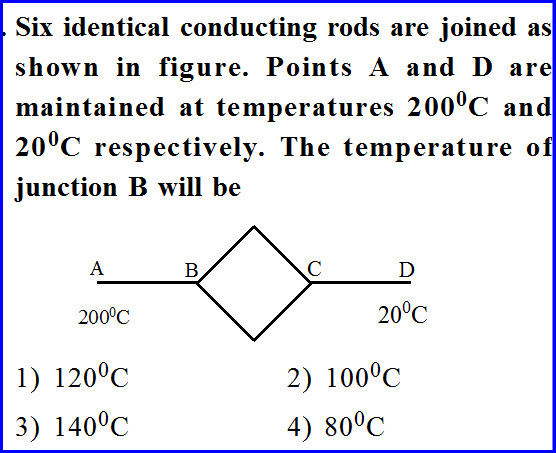

Solution

We can identify that at the junction upper two rods and lower two rods are connected in series and their combination of top and bottom are connected in parallel. Further taking the definition into consideration, we can solve the problem as shown in the diagram below.


Problem

A sphere and cube are made up of same material and they have equal volume. They are heated to the same temperature and allowed to cool in the same surroundings as shown in the diagram below. We need to find the ratio of rate of loss of heat of both of them.


Solution

As the volume of sphere and cube are same, we can find the relation between the radius of the sphere and side of the cube by applying their volume formula as shown in the diagram below. Taking the Stefen’s law into consideration, we can solve the problem as shown in the diagram below.


Related Posts

Transmission of Heat Problems with Solutions Two

We are solving series of problem based on the concept of transmission of heat. In the case of conduction of heat, no particle of the solid medium has the permanent displacement and each particle vibrates about its mean position and transmits heat energy to the next particle and the conduction keeps happening that way. In the case of convection, we need a liquid or gas medium and the particles do get permanent displacement and hence the flow of the heat is quick when compared with the solid. In the case of radiation, there is no need of any medium for the propagation and heat flows like electromagnetic wave. This is the quickest way of transmission of heat and there is no effect on the medium during this transmission of heat.

Problem

Two identical rods of same material are joined in series and certain heat is passing through them for four minutes. If the same two rods are connected in parallel, we need to find the time required for the flow of same heat and the problem is as shown in the diagram below.


Solution

When the rods are connected in series their lengths get added up but area of cross section remains same. In series rate of flow will be the same. When the rods are connected in parallel, the lengths of the system remain same but the area of cross section increases. Here rate of heat flow is shared and the problem is as shown in the diagram below.  


Problem

A block body at temperature at 400 kelvin is placed in the surrounds of temperature of 300k and the rate of flow is given to as r. If the temperature of the body is raised to 800 kelvin, we need to find the rate of flow of heat in this case and the problem is as shown in the diagram below.


Solution

We need to use Stefen’s law that the rate of flow of heat is directly proportional to the forth power of absolute temperature. We shall take that forth power difference in the case of absolute temperature of the body. Taking this into consideration, we can solve the problem as shown in the diagram below.


Problem

Two objects are having same shape and radiating the same power. If their emissivity’s are different as shown in the diagram below, we need to find the temperature of the two bodies and the problem is as shown in the diagram below.


Solution

We know that only perfect elastic body can emit all the heat energy that it has and other bodies can emit heat energy up to some extend basing on the nature of the material. How much heat energy a body can emit is measured with a term called emissivity. For a perfect block body its value is one and for any other bodies it is more than zero but less than one. The rate of emission of heat is directly proportional to the forth power of absolute temperature and emissivity. Taking that into consideration, we can solve the problem as shown in the diagram below.


Problem

Intensity of radiation is 100 units when the source is at a distance d and we need to know the intensity if the distance is doubled and the problem is as shown in the diagram below.


Solution

We know that the intensity is defined as the rate of heat energy per unit area of cross section and it is inversely proportional to the square of the distance of separation from the source to the observer. Taking that into consideration, we can solve the problem as shown in the diagram below.


Problem

A body has taken a time of eight minutes to reduce its temperature from 90 to 80 degree centigrade when it is in a room of surrounding 25 degree centigrade. We need to know the time required to cool the body from 80 to 70 degree centigrade in the same surroundings. Problem is as shown in the diagram below.


Solution

We need to use Newton’s law of cooling to solve this problem and as per it the rate of cooling of a body is directly proportional to the temperature difference between body and surrounding. This rule is valid only when the temperature difference between body and surrounds is small. Taking that into consideration, problem is solved as shown in the diagram below.


Related Posts

Transmission of Heat Problems with Solutions one

We are solving series of problems based on the concept transmission of heat. In this lesson we are going to solve problems based on conduction, convection and radiation. These three are the different modes of transmission of heat. Conduction happens via solid medium, convection happens via fluid medium and for the radiation, we don’t need any medium for the propagation. In the case of conduction, molecules of the solid body vibrates about its mean position and pass the heat energy to the next particle and there is no permanent displacement of the particle. Thus it is the slowest method of transmission of heat and it happens via solids because the molecular force of attraction is strongest.

Problem

In a rod heat is passing through in a study state and the temperature at the both ends is different as given in the problem. If the length of the rod is one meter, we need to find the temperature at a point who is at a distance of 60 centimetre from the first end.


Solution

We know that the rate of heat flow in a solid material it is directly proportional to the area of cross section, temperature difference and is inversely proportional to the length of the rod. Taking that into consideration a proportionality constant is defined. In a given rod rate of flow will be the same but as the length of the rod varies, temperature of the body also varies. Taking that into consideration, we can solve the problem as shown in the diagram below.


Problem

An aluminium rod area of cross section and coefficient of conductivity is given to us and a study of rate of flow of heat 360 calorie per minute is given to us in the problem. We need to find the temperature gradient of the rod and the problem is given as shown in the diagram below.


Solution

Temperature gradient is defined as the ratio of temperature per unit length. We can get the value of this temperature gradient from the definition of coefficient of thermal conductivity. Problem is solved as shown in the diagram below.


Problem

One end of a metal bar is in ice and the end is in contact with stream as shown in the diagram below. Coefficient of thermal conductivity is given to us and we need to find the amount of the ice that melts per minute.


Solution

We know that there is certain amount of heat flows in the rod per second and we can find it using the definition of coefficient of thermal conductivity. This heat energy is used in converting ice into water. All transferred heat is used to convert ice into water. We can get the mass of the ice converted using the definition of latent heat. It is defined as the amount of heat required to convert unit mass of substance from one state to the other. Using these definitions, we can solve the problem as shown in the diagram below.


Problem

Three rods of same length and area of cross section are joined in parallel. Their respective coefficient of thermal conductivity is given to us and we need to find the effective thermal conductivity of the system. Problem is as shown in the diagram below.


Solution

We know that when rods are connected in parallel, the temperature at common point will be the same but the rate of flow of the total heat is the sum of individual values. Taking that into consideration, we can solve the problem as shown in the diagram below.


Problem

Water is changing into ice at zero degree centigrade and atmospheric temperature is much less than that as shown in the diagram below. If the time taken for the formation of ice layer of thickness one centimetre is seven hours we need to find the time taken for the formation of ice layer of thickness two centimetre.


Solution


We can prove that the time taken for the formation of ice layer is directly proportional to the square of thickness of the layer. Taking that into consideration, we can solve the problem as shown in the diagram below.


Related Posts

Thermal Properties of Heat Complete Lesson

Heat is a disordered form of energy and to know the direction of flow of the heat, we need the concept of temperature. Temperature is a measure of the heat energy. Heat is measured with a unit called calorie and temperature is measured with kelvin in the standard international system. The rise in the temperature of a body causes the expansion in general in the body and it is called thermal expansion. To study this expansions, we need coefficients of expansions and they were separately defined for solid state, liquid state and gaseous state materials. 

Heat flows from one place to other in different ways called conduction, convection and radiation. Conduction need a solid medium, convection need a fluid media and radiation is not in need of any media for the propagation.

Here in this lesson we have discussed about all this topics in detail.

Expansion of Solids and Applications
                                                     

Anomalous expansion of water 

Expansion of Liquids Problems with Solutions


Newton’s law of cooling

Newton’s law of cooling

When a hot body is placed in a room it emits heat energy because of the combined effect of convection as well as radiation. The amount of the heat energy that it can emit per one second can be calculated using this law.

According to this law the rate of loss of heat energy is directly proportional to temperature difference between the body and the surroundings.

It simply means that when the difference between the body temperature the surroundings temperature is more, the loss of heat energy will be quick and vice versa.

It can be also proved that the rate of loss of heat energy is equal to the rate of change of temperature.

We can also state the law as the rate of loss of temperature is directly proportional to the temperature difference between the body and the surroundings.

This law is valid only when the temperature difference between the body and surrounding is small.


Problem and solution

A body at  temperature of hundred degrees centigrade is brought in the room of temperature 20°C. To cool from hundred degrees centigrade and 80°C has taken a time of 10 minutes. How much further time it will take to cool from 80°C to 60°C?

We have to solve this problem basing on the Newton law cooling.

The rate of loss of heat energy or the rate of loss of temperature is directly proportional to temperature difference between the body and surroundings. By applying this rule to the two different cases available we can solve the problem as shown.


Related Posts

Thermal resistance and Conductors in Series and Parallel

Thermal resistance

The rate of flow of heat energy through a given solid material is directly proportional to temperature difference between the two ends of the rod.

The rate of flow of the heat is inversely proportional to the combination of length area and coefficient of thermal conductivity as shown.

Thermal resistance can be defined as the ratio of length of the material to the coefficient of thermal conductivity and the area of cross-section.

Thermal resistance is a measure of opposition to the flow of heat.

More the thermal resistance it becomes difficult for the heat energy to flow from one place to another place.

Thermal resistance is similar to electric resistance.

Resultant coefficient of thermal conductivity when rods are connected in series

When different materials are connected with different coefficients of thermal conductivity, we can calculate the effective coefficient of thermal conductivity.

When the rods are connected in series the same rate of flow happens through both the parts. But the temperature difference in the different junctions is going to be different because of the receiving of different heat energy.

The temperature difference between the first and the last end is equal to the sum of temperature difference between the junctions as shown.

The effective thermal resistance when the 2 rods are connected in series is equal to the sum of the individual thermal resistances.


When the two materials are connected in series are having the same physical dimensions, we can derive a simple equation for the effective coefficient of thermal conductivity as shown below.


Effective thermal conductivity when the rods are connected in parallel

When different materials are connected in parallel the total available heat energy per second will be shared across both of them.

Anyway the temperature at the end is going to be the same.

The effect to thermal resistance when the rods are connected is similar to the electric resistance when the rods are connected in parallel.

When the two different rods are having same length and same area of cross-section we can derive a simple equation for the effect to coefficient of thermal conductivity as shown below.


Problem and solution

The solid material having the coefficient of thermal conductivity of 50 SI units is having a length of 1 m and area of cross-section of 5 cm Squire. One end of the rod is placed in the ice and other end is in the steam. How much ice melts in five minutes?

We know that rate of flow of heat can be expressed in terms of coefficient of thermal conductivity as per the definition.

Latent heat is defined as the amount of the heat energy required to convert unit mass of substance from one state to another state at constant temperature. We can equate the rate of flow of heat energy to read of energy required to convert the total mass of substance from one state to another.

By equating both the energies we can get the answer as shown below.


Problem and solution

When two different metals of coefficient of thermal conductivity three and four SI units are connected in series and parallel what is the ratio of their effect to coefficient of thermal conductivity? Assume that both are having similar physical dimensions.

We know that effect to coefficient of thermal conductivity value both the series combination as well as the parallel combination. They were derived in the previous post.

We can use those formulas to solve this problem.

There is another problem on the same page.

Two materials of same thermal conductivity and same dimensions are connected in series pass heat of two joule’s per second. When they are connected in parallel how much heat we can pass per second?

We can solve this problem using the concept of resistance. We know that when the rods are connected in series effective resistance increases and when they are connected in parallel effective resistance decreases.

Using their corresponding formula which is derived in the previous lessons we can substitute and get the required answer.


Related Posts